
Warehousing in 2026: From Storage Function to Strategic Growth Engine
Warehousing is no longer just about storing goods. In 2026, it has become one of the most critical drivers of supply chain performance, influencing delivery speed, working capital efficiency, and business scalability.
With the Indian warehousing market currently surging toward a $35 billion valuation by 2027, growing at a 15% CAGR, the companies winning today are not simply moving freight; they are managing intelligence.
The Shift: From Traditional Warehouses to Smart Fulfillment Hubs
For years, warehouses were operational necessities places to hold stock until dispatch. Decisions were reactive, and reporting was periodic. But in a 2026 economy, that model is obsolete.
Today’s warehouse is a data-driven fulfillment hub. The focus has shifted from “how much can we store” to “how efficiently can we move.”
- The Precision Standard: Modern hubs leveraging AI-integrated Warehouse Management Systems (WMS) now achieve 99.9% order accuracy, a baseline requirement for modern retail.
- The Speed Factor: Fulfillment centers are no longer just on the outskirts. The rise of dark stores and micro-fulfillment centers has redefined the “last mile.”
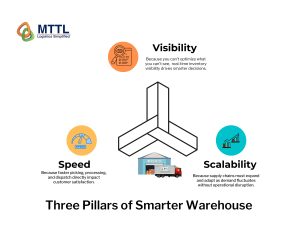
Why Warehousing is a Strategic Priority in 2026
1. The Omnichannel & Q-Commerce Revolution
Modern warehousing integrates multi-channel fulfillment under one ecosystem. With the Indian Quick Commerce (Q-Commerce) market reaching $3.65 billion in 2026, warehouses must process bulk B2B dispatches and individual “10-minute” orders simultaneously.
Market Insight: Approximately 62% of quick commerce orders now demand a sub-10-minute delivery window, making strategically placed hubs a survival requirement.
2. Regional Expansion: The Tier 2 & 3 Surge
Speed is no longer limited to metros. Strategically located warehouses closer to demand centers reduce last-mile costs.
- New Growth Hubs: Emerging Tier 2 and Tier 3 cities now contribute approximately 18.7% of India’s total warehousing stock, reaching nearly 100 million sq. ft.
- Grade A Preference: Grade A spaces now constitute roughly 30% of the inventory in these emerging cities as brands seek global-standard reliability.
3. Infrastructure & Inventory Optimization
The Union Budget 2026-27 has reinforced this growth with a record ₹12.22 lakh crore in public capital expenditure dedicated to infrastructure and logistics. This push helps businesses maintain the right inventory at the right time.
AI-driven demand forecasting is helping businesses reduce “dead stock” by up to 25%, directly freeing up working capital for expansion.
Sustainability: More Than Just “Being Green”
In 2026, sustainability isn’t just a trend it’s how the most successful businesses save money and win big contracts.
The government is pushing to install 40 GW of rooftop solar by 2026. For you, this means your warehouse roof is now a miniature power plant.
- The Benefit: By switching to solar, warehouses are drastically cutting their monthly electricity bills.
- Resilience: With battery storage, your warehouse can keep running even during grid power cuts, which is vital for 24/7 operations.
Looking Ahead
As supply chains grow more complex, warehousing can no longer remain a passive function. It must evolve into a strategic ecosystem that supports operational resilience and long-term scalability.
At Max Transtech Limited, we believe warehousing should not just store inventory—it should empower performance. The businesses that rethink warehousing today will move faster, operate smarter, and scale stronger tomorrow.
References
- DBS Bank. (2026). Union Budget 2026 Impact: Key Sector Analysis & Insights. https://www.dbs.bank.in/digibank/in/articles/save/impact-of-union-budget-2026
- India Briefing. (2025). Tier 2 and 3 Cities Fueling India’s Logistics, Warehousing Growth. https://www.india-briefing.com/news/tier-2-and-3-cities-fueling-indias-logistics-warehousing-growth-36392.html/
- JLL India. (2025). India’s warehousing boom: Tier II-III cities drive 100M sq. ft. https://www.jll.com/en-in/newsroom/indias-warehousing-boom-tier-ii-iii-cities-drive-100m-sq-ft
- Mordor Intelligence. (2026). India Q-Commerce Market Size & Share Analysis. https://www.mordorintelligence.com/industry-reports/q-commerce-industry-in-india
- Nexdigm. (2024). India Warehousing Market Outlook to 2030. https://www.nexdigm.com/market-research/report-store/india-warehousing-market/
- TCIL. (2024). Logistics for India’s Renewable Energy Revolution. https://tcil.com/wp-content/uploads/2024/12/Logistics_Focus_Dec_2024.pdf
- Warehousing Association of India. (2022). Ease of Doing Warehousing Business in India. https://warehousingindia.org/wp-content/uploads/2022/11/Ease-of-Doing-Warehousing-Business-in-India-Digital-version.pdf